
Description
Jan 2020 - 23
Antique American Clocks
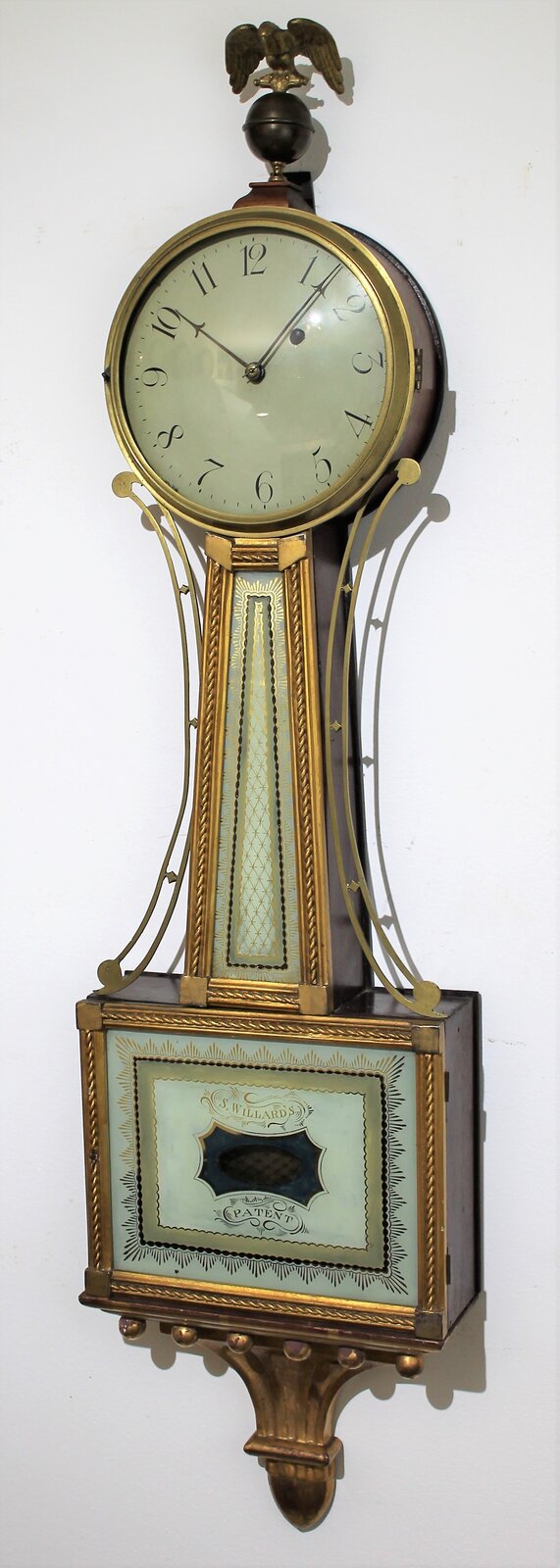
Curtis & Dunning (attr.) presentation banjo, ca. 1825.
We can't be sure this is Curtis
& Dunning as there is no signature on the dial, but it has many features characteristic of these makers.
Note the movement
with a butterfly bridge, the characteristic pendulum keystone with the lower right cutout, and the straight click pawl.
comparison see Chapter 13, Vermont Timepieces, in Foley's book
Willard's Patent Time Pieces
The pinned movement was likely
originally mounted to the thick chestnut(?) backboard by a single center screw but is now held in place with two screws at the upper
right and lower left corners of the backplate.
The curved cutout of the upper right top plate is probably to facilitate access
to the upper mounting screw.
The case is cutout to fit the corners of the movement, as it seen with other banjos from this maker.
The movement is driven by a lead weight and is running vigorously and keeping good time.
The heavy iron dial is held in place
by two j-hooks and seems likely to have been repainted some time ago, as many Curtis and Dunning banjos had a distinctive dial pattern.
The hand-made hands are very old and typical of the period; there is a heavy brass bezel with a curved glass.
The throat and
tablet are in excellent condition and appear to be original paintings, with "S. Willard's Patent" on the lower glass.
rope trim and gilt base are in remarkably good shape for almost 200 years.
The only aspect of this clock that looks questionable
is the eagle finial on top; it should also be noted that part of the pendulum tie-down and the door latch and handle are missing.
We picked this up at a local auction where it was one of only a few antique clocks from a fine Kentucky estate.
time I did not have access to the movement, so it was a pleasant surprise when I removed the dial.
Prices for Curtis & Dunning
clocks vary greatly with condition and style, but $1500-$2500 seems about right here.
Record courtesy of AntiqueAmericanClocks.com