
Description
Jul 2021 - #199
Antique American Clocks
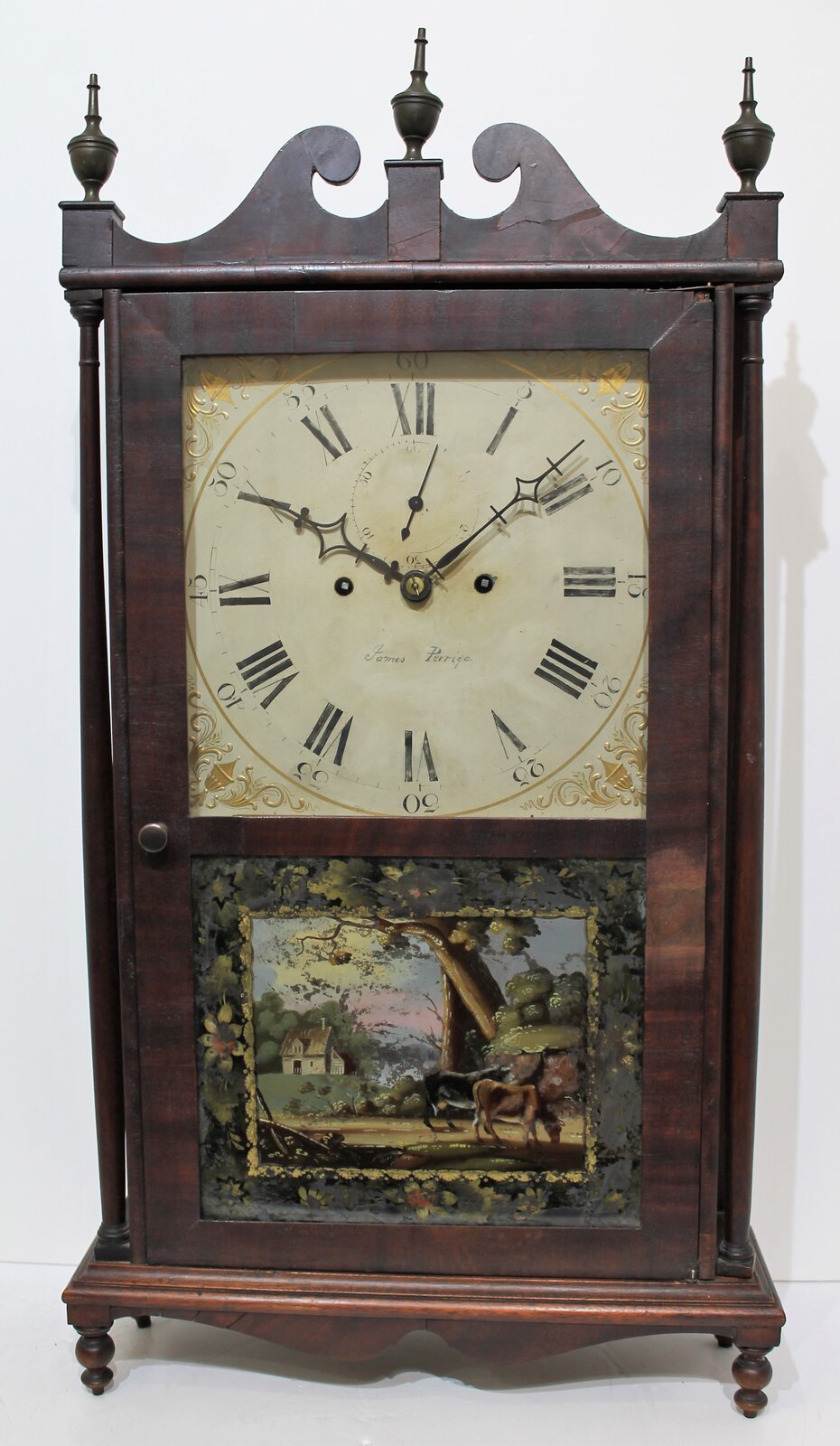
James Perrigo brass movement pillar & scroll, ca. 1825?
James Perrigo Sr. died in 1808; he made wooden
works tall-case clocks.
His son, James Perrigo Jr. appears to have been active in clocks in the early 1800's, but this would
be the only known example.
Both worked out of Wrentham MA.
It is possible that James Perrigo, Jr. made this clock sometime
after 1823.
The 29.5-inch case is veneered in mahogany with an old and dark finish.
The brass urn finials are mounted
on wooden posts, the turned feet are unusual; both scrolls have been broken off and reglued.
Both glasses are period and both
are held in place with wooden strips rather than putty, so they could be replacements.
The interesting and atypical tablet shows
considerable losses.
The iron dial holds the original paint with gesso decorations on the corners, unusual for a metal dial.
The hands are original, the hour hand with two diagonal pins holding it in place; the seconds hand is a modern replacement.
There is little of the original James Perrigo signature on the dial, with most of it penned in later.
The brass movement is
similar (or identical) to a Salem Bridge movement, unsigned, and would not run or strike when I hung 30-hour weights (not included,
but 30-hour weights can be purchased in Parts - #603).
The weights are compounded on mismatched pulleys.
The back of the
case is cut out to match the movement, indicating that this movement and the backwall go together; there is no evidence of another
movement having been used.
There is no label to go on.
This clock is an enigma, and to further muddy the water, there
is a metal print block showing the clock on a fireplace mantel, suggesting a photo was published in a newspaper.
$250-$1000.
Stehlik suggested to me that this is an 8-day Salem Bridge movement, given the compounded weight cords. I tested 8-day weights
but couldn't get it to run, but I think he is right. Thanks Jim!
Record courtesy of AntiqueAmericanClocks.com