
Description
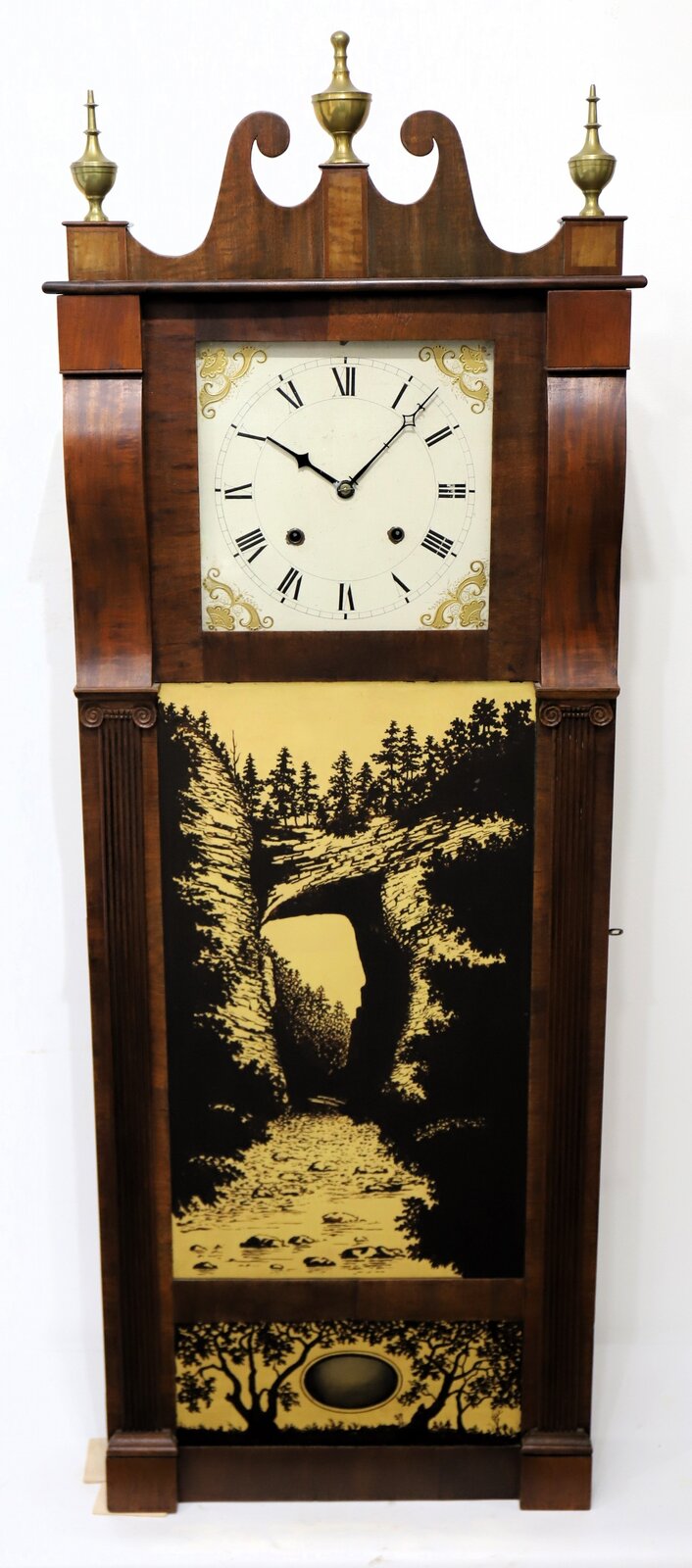
Joseph Ives New England mirror clock, ca. 1820. Yes, a lawsuit should be filed against the person who desecrated this iconic clock. But it has some redeeming value, if you look at the movement – not what you would expect. The 47-inch case (without the replacement crest) has good walnut/mahogany veneer with a clean finish. Note the ribbed pilasters on each side with carved capitals. The crest is interesting and well-done, but not quite a perfect match. The brass urn finials are on steel posts (left and right) and the larger center finial is on a wooden post. There is a working lock and key on the right side and the dial glass is old but probably a replacement; who cares about the other two glasses (the center should be a mirror and could be easily replaced). The heavy cast iron dial is simple, with gilded decorations and clean, with little chipping. The hands look fine, but the hour hand is a modern hand-made cutout. Now for the movement: it is a rare (haven’t see one before) skeletonized front plate. The backplate is steel, as are the posts, and it is set into a cutout in the backwall. It is an 8-day, time-and-strike movement driven by two almost 9-lb cast iron weights. It is running but will not strike, as the winding drum gear is not attached to the winding drum, so the click-stop does not catch. Probably not a difficult fix for someone with more skill than me; I think solder would be involved. It strikes on the large cast iron bell immediately below the movement and has a rack and snail strike mechanism. The pendulum rod and bob seem period/original, and the interior has the typical Ives green wash. There are more holes in the backboard than I like, and no evidence of a label. Must be worth something. $750–$1000. Viewing on a smart phone? Turn it sideways!
Record courtesy of AntiqueAmericanClocks.com