
Search Antique Clocks
Showing 521–540
of 690 clocks
by Howard
-
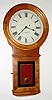 E. Howard and Co., "REGULATOR No. 70", Circa 1895, in cherry, weight driven 8-day timepiece.
 -
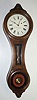 E. Howard and Co, Boston, "REGULATOR No. 10", figure 8 wall clock, in a walnut case with reverse painted tablets, invar pendulum rod, eight day, serial No. 331, C.1976, along with its framed certificate of origin, dated Nov 1, 1976 and signed by D. J. Blackwell. Consigned by the original purchaser, H. Newman.
 -
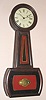 E. Howard and Co., Boston, C.1900, No. 5 Banjo, in a rosewood grained cherry case, 8-day weight driven, purchased through Peter Sawyer in 1990.
 -
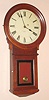 E. Howard and Co., Boston, C.1890, "REGULATOR No. 70", in a cherry case, weight driven, 8-day, 12 inch dial.
 -
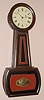 E. Howard and Co., Boston, C.1860 {with double signed movement, A. Howard to the left and E. Howard to the right}, No. 4 BANJO, in a rosewood grained cherry case,
 -
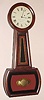 Howard and Davis, Boston, C.1850, No. 3 BANJO, in a cherry case, weight driven, 8-day, with restorations.
 -
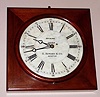 E. Howard Clock Co., Boston, MARBLE DIAL clock in a square mahogany case with 16 inch round marble dial, inscribed for the Independent Order of Odd Fellows, Sept 24, 1920, the mahogany case measuring 22 inches on each side.
 -
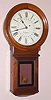 E. Howard and Co., Boston, "No. 70, PROGRAM CONTACT CLOCK", based on the No. 70 regulator and with and iron back behind the circular, laminated head, the dial insulated from the iron back on 4 wooden blocks, and with 2 bronze rings with holes at 5 minute intervals, the rings wired to an electrical stud in top of clock and the iron back/movement wired to the other stud. Walnut case. C.1910
 -
 C.1975, a repro Howard model 59-6, in walnut, with a C.1900 Howard 70 nickel plated mov't. This was made by Mr. Lee in Florida just as Howard repros were coming into vogue, and the quality is very fine; carved lower finials are exceptional, and he chose a nice piece of bird's eye maple for the baffle.
 -
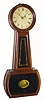 Howard and Davis, Boston, "No. 2 Banjo" wall timepiece, 8-day weight driven in a walnut case, C.1855
 -
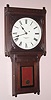 E. Howard and Co., Boston, C.1890, REGULATOR No. 75, in walnut, 8-day, weight driven.
 -
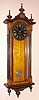 E. Howard and Co., Boston, REGULATOR No. 59-8, walnut cased timepiece in the Viennese style, commonly called a "Howard Vienna", this one with painted black dial.
 -
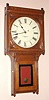 E. Howard and Co., c.1890, "REGULATOR No. 75", in oak, 8-day, weight driven timepiece.
 -
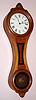 E. Howard and Co., Boston, C.1890, REGULATOR No. 10, figure 8 wall timepiece in walnut, 8-day, weight.
 -
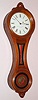 E. Howard and Co., Boston, C.1890, "REGULATOR No. 9", figure 8 wall clock in walnut, weight driven, eight day.
 -
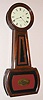 E. Howard and Co., Boston, C.1890, "No. 2 BANJO", in a rosewood grained cherry case, weight driven, 8-day.
 -
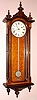 E. Howard and Co., Boston, REGULATOR No. 59, smallest size timepiece with 6" dial, weight driven, 8-day, C.1880, in a walnut case, glazed sides and with ebonized accents, three carved finials at bottom and 3 turned finials at top.
 -
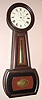 E. Howard and Co., Boston, C.1900, "No. 1 BANJO", in a rosewood grained cherry case, full regulator size with seconds beating pendulum.
 -
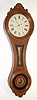 E. Howard and Co., Boston, "REGULATOR No. 7", figure 8 wall clock, C.1880, in a black walnut case, 8-day, time, weight driven.
 -
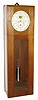 E. Howard and Co., Boston, extremely fine "Astronomical Regulator No. 74", C.1874, with 4-legged gravity escapement, mov't exceptionally well jeweled, including the front and rear pivots for both gravity arms, the lifting piece of both gravity arms and the stop surface for the 'scape wheel on both arms. The gravity escapement was Howard's most expensive option available on movements for both observatory timepieces and tower clocks, and it is rare to find the jewelling this extensive. There are engravings inside the maintaining power wheel: "L.P.E 1874,, cleaned 3-1884 LPE,, put up in supt's office 3-1892-LPE,, CLD 1-1900 LPE,, New Wire Cord 1902 LPE". LPE most assuredly refers to L. P. Emerson, Foreman of the movement department at the Howard Clock Factory. Dana Blackwell reported that Emerson was also in charge of setting up special trains and escapements. Clock retains original signed 24 hour dial. The laboratory style case is actually a double-door cover that attaches to the back in two pieces, held on with screws from the side; normal access is through the front doors. This lot is accompanied by two pendulums.