
Search Antique Clocks
Showing 5,241–5,260
of 7,426 clocks
type Wall
-
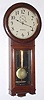 Seth Thomas Clock Co., Thomaston, Conn, "REGULATOR No. 2", Circa 1880, 8-day weight driven timepiece in mahogany.
-
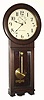 Seth Thomas Clock Co., "Regulator No. 2", Circa 1900, 8-day mahogany wall timepiece, with large 77B movement with dead beat escapement and maintaining power.
-
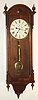 Seth Thomas Clock Co., "REGULATOR No. 6", C.1975 re-issue, serial No. 296 of 4000, in a walnut case, 8-day, weight driven.
-
 Ansonia Clock Co., "PROMPT", Circa 1901, 8-day spring, time and gong strike in an oak case with carved trim.
-
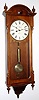 Seth Thomas Clock Co., C.1977 {dated}, "REGULATOR No. 6", re-issue, complete with label and crank, 8-day, weight driven.
-
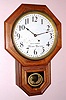 Seth Thomas Clock Co, C.1891 {dated on rear}, 12 short drop octagon, made under contract for Union Pacific Railway. Note the dial is signed Union Pacific, the label [40% missing] is special for Union Pacific, and the rear of the case is also stenciled "Union Pacific".
-
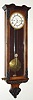 Austrian, Adolf Koll, Wien, Biedermeier era "Vienna Regulator", full quarter striking grand sonnerie, weight driven, with springs for the striking trains, 2-day. The case with rosewood veneer on outer surfaces, front of back is grained, slide mount movement on seatboard.
-
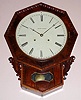 Chauncey Jerome, New Haven, Conn, C.1850, 2-Fusee, 8-day short drop ripple molded octagon, with Jerome's unique and LARGE double fusee movement, and the octagon turned one sixteenth, as Jerome chose for this model.
-
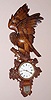 Swiss carved wall clock from the Interlaken region of Switzerland well known for producing these quality carved clocks, unknown hardwood with finely carved eagle peering out with life-like glass eyes perched on roost containing French 8 day time only clock movement with platform lever escapement and Roman numeral porcelain dial, c1900
-
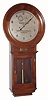 Warren Telechron Co., Ashland, Mass, C. 1925, "Warren 'B' Master Clock", (No. 127 Frequency Clock), in a walnut case, and silvered dial, 110v motor combined with quality spring mov't. Spring mov't moves the center hand backwards; electric mov't moves it forward. Cord was disconnected after checking. It is inside case. Note that you should attach cord and just plug it in; there is NO need to ever wind it again. An additional note is if you stop the pendulum and leave the electric motor running, it can strip off the 'scape teeth {something has to give}.
-
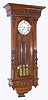 Austrian, 3-wt Grand Sonnerie, full quarter striking wall clock, in a walnut case, C.1875
-
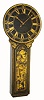 English, Time and bell strike TAVERN CLOCK, 26" dial with gilt Roman numerals, in a Chinoiserie case, the with raised figures in period dress, amongst gardens and temples, C.1800.
-
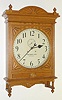 Seth Thomas Clock Co., Thomaston, Conn, C.1896, oak cased "LOBBY 18 INCH", with 15-day duplex spring timepiece movement.
-
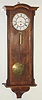 German (unsigned Lenzkirch), Regulator No. 5 {see "Vienna Regulators" by Dana Blackwell, pg 53}, as-found, less finials and top.
-
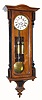 Austrian, Vienna Regulator, 2-weight wall clock, gong striking, in a simple transitional style walnut case, less top trim, C.1865
-
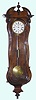 Austrian, "Vienna Regulator" one-wt timepiece, in a serpentine wall case, C.1860.
-
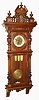 German, Gustav Becker, C.1895, 3-wt Grand Sonnerie "Vienna Regulator" in the Alt Deutsch double door style., 8-day [full quarter striking].
-
 German, Gustav Becker, Freiburg S, c.1871, small 1-wt "Vienna Regulator" in a walnut veneer case, with burled back panel and ebonized finials and trim, and with 4.25" dial, serial No. 43286.
-
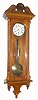 Austrian, smaller 1-wt time only Vienna Regulator with 4.5" dial, in a light walnut case, the movement showing "K. Bert, Wien" on the fine porcelain dial, 8-day, C.1880.
-
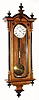 Austrian, 30-Day Vienna Regulator in a nice transitional case with smooth side columns, with ebonized accents. Has a good movement with Harrison's ratchet maintaining power. Remember to wind to the left.