
Search Antique Clocks
Showing 8,881–8,900
of 10,191 clocks
type Shelf
-
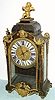 C.1750, French, Massoii, Paris, Boulle clock with tortoise shell and brass inlay with unique single spring time, qtr strike and repeat movement, with 3 bells atop case.
-
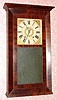 C.1835, George Marsh (partial label), 8-Day, wooden works, beveled case with straight cornice.
-
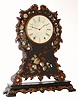 C.1842, Case of Litchfield Mfg with its original Jerome 8-day pendulum movement, on its original base, formerly in the collection of William [Bill] Wadleigh, and the Very Clock shown in Horology Americana, page 194.
-
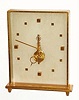 C.1985, Swiss, LeCoultre, Desk timepiece, a gilt brass frame, with a rear wind 16j movement, stacked vertically in skeleton style, the balance at the apex, with gilt brass studs for numerals on a frosted background.
-
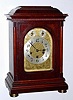 C.1920, German, Junghans, WESTIMINSTER Chime bracket or table clock, in a mahogany case and with embossed brass dial.
-
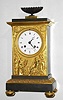 C.1840, French, Gaston Jolly, Paris, Bronze and Ormolu, Empire style mantel clock, 8-day bell strike with silk thread suspension, commemorative to Achille and Ulysse, shields in top corners with their names.
-
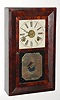 C.1848, Wm. S. Johnson, 16 Courtlandt St, New York, mini bevel front, 1-day, double fusee, with separate alarm mov't on base.
-
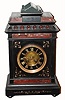 C.1895, French, Japy Freres and Cie, Black slate with red/gold accents mantel clock, 8-day gong striking.
-
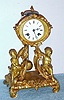 C.1850, French, Japy Farres, Paris: French Ormolu miniature shelf clock with cherubs and 8-day time and strike movement, the dial set into an oval easel.
-
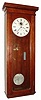 C.1910, E. Howard and Co, Weight driven master clock, in walnut case, 8-day.
-
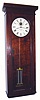 C.1920, E. Howard and Co., Master clock with 2-vial mercury pendulum, modified with Telechron 110 v. motor for winding.
-
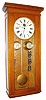 C.1910, E. Howard and Co., Boston, Electric Self Winding master clock [DC] with 2 pilot clocks, bell ringing system [no tape], in a golden oak case.
-
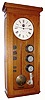 C.1915, E. Howard and Co., Boston, Electric Self Winding master clock [DC] with 3 pilot clocks, golden oak case.
-
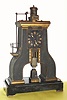 C.1880. French, Guilmet, Paris, "STEAM HAMMER" Clock from the Industrial Series, with a complex pendulum that changes power direction 7 times before reaching the final "pendulum hammer".
-
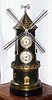 C.1880, French, Guilmet, Paris, "WINDMILL", clock from the Industrial series, a timepiece movement in the tower, and the mill blades turned via a cord travelling up the tower from a separate movement in the base, and wound by opening the "door of the mill", and with an Aneroid barometer above the clock.
-
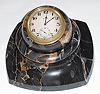 C.1930, Swiss, Gubelin, Gray marble desk clock, a jeweled rim wind clock, set into a variegated marble ball, which in turn sets into a matching recess in the marble base, so that it can be swiveled to any angle for viewing. Pull rim up for setting hands.
-
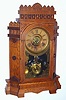 C.1885, Wm. L. Gilbert, ALTAI, pressed oak parlor clock with canted sides and fancy top, 8-day time, strike on cathedral gong, and with alarm.
-
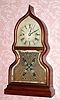 C.1850, Forestville Manufacturing Company, Bristol, Conn, acorn shelf clock with original 8-day time and strike signed fusee movement.
-
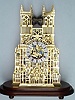 C.1870, Wm. Frederick Evans, 3-fusee chiming on 8 bells, WESTMINSTER ABBEY, skeleton clock with dome, retailed by Wm Gibson, Belfast (engravings at bottoms of towers), and with 2 vial compensating pendulum.
-
![C.1790, Austrian, Gaetano Endres, Gorizia (in the Carnic Alps], early Grand Sonnerie bracket clock in a carved and ebonized baroque case, multi piece dial with mock pendulum and dials for strike/no strike.](/images/robertoschmitt16/t147.jpg) C.1790, Austrian, Gaetano Endres, Gorizia (in the Carnic Alps], early Grand Sonnerie bracket clock in a carved and ebonized baroque case, multi piece dial with mock pendulum and dials for strike/no strike.